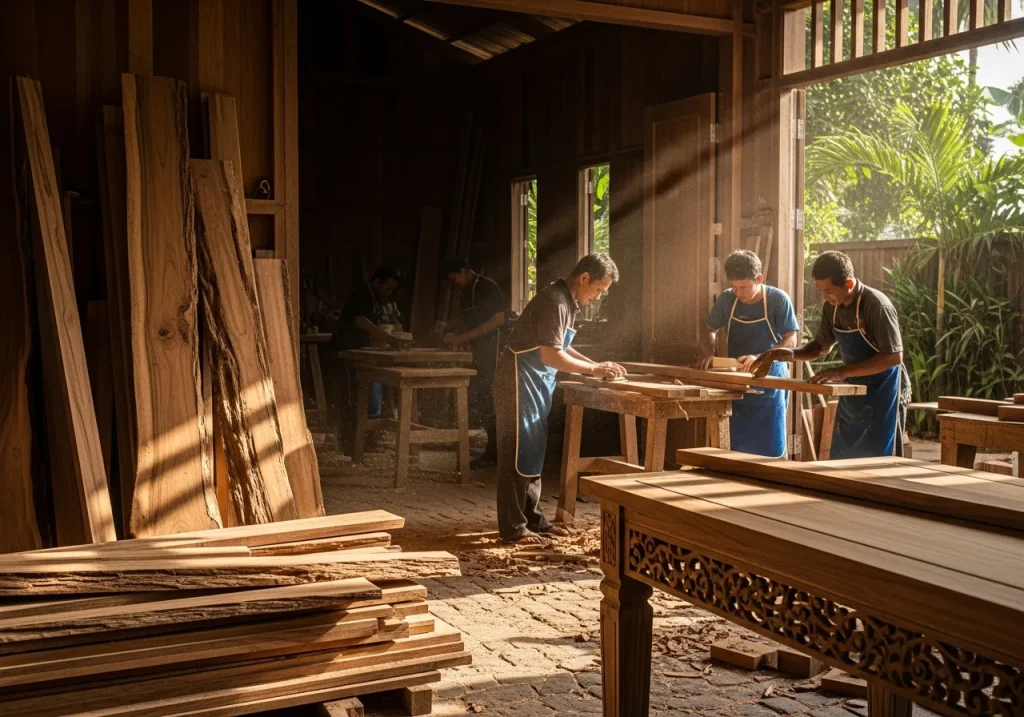
The global teak furniture market, valued between USD 3.8 and 8.5 billion, is projected to grow at a CAGR of 4–6% to the early 2030s, driven by hospitality projects and demand for durable outdoor furniture. Bali, a key craft and export hub, offers teak furniture ranging from USD 50 for small items to over USD 2,000 for premium sets.
Cost Guide: How to Import Teak Furniture from Bali to the US Without Breaking the Bank
Importing teak furniture from Bali to the United States requires a clear understanding of costs and processes. As a B2B export house, Teak Furniture Bali assists importers, wholesalers, retailers, and interior contractors in navigating these complexities. This guide details the primary expenses and considerations for importing Bali teak furniture, particularly for commercial applications like cafes, ensuring a cost-effective approach.
Understanding the Bali Teak Furniture Market
The teak furniture market relevant to Bali and Indonesia is experiencing steady growth, projected at mid-single-digit rates through 2027. This growth is fuelled by increasing tourism, significant hospitality project developments, and consistent global demand for durable outdoor furniture. Bali stands as a major craft and export hub within Indonesia’s broader teak and wooden furniture industry.
Prices for teak furniture from Bali vary based on design, size, and certification status. Small items typically range from USD 50 to USD 150. Premium sets, often destined for high-end hospitality or retail, can cost upwards of USD 500 to USD 2,000 or more. These figures provide a baseline for initial budgeting.
The global teak furniture market is valued approximately between USD 3.8 billion and USD 8.5 billion, with a projected Compound Annual Growth Rate (CAGR) of 4–6% extending into the early 2030s. Specific reports estimate the teak wood furniture market at USD 3.65 billion in 2025, forecast to reach USD 4.84 billion by 2034 (4.1% CAGR). Another perspective places the broader teak furniture market at USD 3.8 billion in 2025, expanding to USD 6.4 billion by 2034 (5.9% CAGR). A third methodology values teak furniture at USD 36.9 billion in 2026, with a 5.5% CAGR to 2033. Across these analyses, the Asia-Pacific region consistently leads both production and consumption.
The Asia-Pacific wooden furniture market, encompassing all wood species, was valued at USD 166 billion in 2025, expected to reach USD 173.9 billion in 2026 and USD 287.4 billion by 2035, demonstrating a 5.7% CAGR (2026–2035). Indoor wooden furniture constitutes a dominant share, representing 78.4% (USD 130.2 billion) in 2025. Furthermore, Asia-Pacific holds over 45% of the global solid wood furniture market share. Indonesia is a major global producer of teak, alongside India and Myanmar, providing a strong supply base for teak furniture exports. Asia-Pacific is projected to hold 51.8% of the global teak furniture market share in 2026.
2027 Note on Market Dynamics
By 2027, the demand for Bali teak furniture for cafe and restaurant projects is expected to remain robust. The ongoing recovery and expansion of the global hospitality sector will continue to drive wholesale orders for durable, aesthetically pleasing outdoor and indoor furniture. Importers should anticipate consistent lead times and potentially stable pricing, provided raw material supply chains remain efficient.
Key Cost Components for Importing Teak Furniture
Understanding the full cost structure is crucial for accurate budgeting. The primary cost components include:
- Product Cost: This is the wholesale price of the furniture itself from Teak Furniture Bali.
- Shipping Costs: Encompasses freight from Bali to your US port, including ocean freight and any surcharges.
- Customs Duties and Taxes: Tariffs imposed by the US government on imported goods.
- Inland Transportation: Costs to move the container from the US port to your final destination warehouse.
- Insurance: Coverage for potential damage or loss during transit.
- Documentation and Port Charges: Various fees for customs clearance, handling, and port services.
Detailed Breakdown of Import Costs
Product Cost (FOB Bali)
The price of Bali teak furniture for cafe projects varies significantly. For wholesale orders, Teak Furniture Bali provides competitive pricing based on volume and specific designs. For example, a single teak cafe chair might be USD 80–150, while a larger cafe table could be USD 300–800. These are factory-gate prices, often quoted Free On Board (FOB) from a port like Surabaya or Semarang, Indonesia, covering local transport and loading onto the vessel.
Shipping and Freight Costs
Ocean freight is a substantial component. Costs are typically calculated per container (e.g., 20-foot or 40-foot). As of recent data, a 20-foot container from Southeast Asia to the US West Coast (e.g., Los Angeles/Long Beach) might range from USD 2,000 to USD 4,000, while a 40-foot container could be USD 3,000 to USD 6,000. These are approximate and subject to market fluctuations, fuel surcharges, and port congestion. Shipping to the US East Coast (e.g., New York/New Jersey) will generally incur higher costs due to longer transit distances.
Customs Duties and Tariffs
Teak furniture imported into the US is subject to specific Harmonized Tariff Schedule (HTS) codes. For wooden furniture, duties can range from 0% to 4.8% or higher, depending on the specific item and country of origin. It is crucial to verify the exact HTS code for your specific furniture items to calculate duties accurately. For example, chairs of tropical wood (HTS 9401.69.0040) might have a duty rate, while other furniture (HTS 9403.60.8081) might differ. Additionally, there may be other fees, such as the Merchandise Processing Fee (MPF) and Harbour Maintenance Fee (HMF).
Inland Transportation
Once your container arrives at a US port, it needs to be transported to your warehouse or distribution centre. This involves trucking costs, which vary based on distance, fuel prices, and truck availability. For instance, moving a 40-foot container from Los Angeles to a location 500 miles inland could cost USD 1,000–2,500. For longer distances or specific regional challenges, these costs can be higher.
Insurance
Cargo insurance is highly recommended to protect against damage, loss, or theft during transit. The cost is typically a small percentage of the total declared value of the goods, often around 0.5% to 1.5%. While optional, it provides critical financial protection against unforeseen events.
Documentation and Port Charges
These are various administrative and logistical fees. They include:
- Customs Broker Fees: Essential for navigating US customs regulations. Fees typically range from USD 150 to USD 300 per shipment.
- Terminal Handling Charges (THC): Levied by the port for handling the container.
- Demurrage and Detention: Charges incurred if containers are not picked up or returned within free time limits. Careful planning can mitigate these.
- Security Fees: US Customs and Border Protection (CBP) fees.
Example Cost Estimate for a 40-Foot Container of Bali Teak Cafe Furniture
To illustrate, consider importing a 40-foot container of Bali teak furniture for cafe use, with a total product value of USD 25,000 (FOB Surabaya).
| Cost Category | Estimated Range (USD) | Notes |
|---|---|---|
| Product Cost (FOB Surabaya) | 25,000 | Wholesale value of teak cafe furniture |
| Ocean Freight (Bali to US West Coast) | 3,000 – 6,000 | 40-foot container, subject to market rates |
| Customs Duties (e.g., 4.8% of product value) | 1,200 | Based on USD 25,000 product value |
| Merchandise Processing Fee (MPF) | Approx. 0.3464% of value (max USD 587.70) | ~86.60 |
| Harbour Maintenance Fee (HMF) | Approx. 0.125% of value | ~31.25 |
| Customs Broker Fees | 150 – 300 | For professional customs clearance |
| Inland Transportation (US Port to Warehouse) | 1,000 – 2,500 | Varies by distance and region |
| Cargo Insurance (e.g., 1% of total value) | 250 | Based on USD 25,000 product value |
| Port & Terminal Charges (THC, etc.) | 300 – 600 | Local port fees |
| Total Estimated Cost (excluding product cost) | 6,017.85 – 9,967.85 | |
| Total Estimated Cost (including product cost) | 31,017.85 – 34,967.85 |
This example demonstrates that the non-product costs can add approximately 24% to 40% to the FOB value of the goods. Effective planning and supplier communication can help manage these expenses.
Strategies for Cost-Effective Importing
Consolidation and Container Optimisation
Maximising container space is crucial. Teak Furniture Bali can assist in planning your order to efficiently fill a 20-foot or 40-foot container, reducing per-unit shipping costs. For smaller orders, consider Less than Container Load (LCL) options, though LCL typically has higher per-unit costs due to consolidation fees.
Working with Experienced Exporters and Brokers
Partnering with an experienced exporter like Teak Furniture Bali simplifies the process. We understand the local logistics, production timelines, and export documentation. Similarly, engaging a reputable US customs broker is essential for smooth customs clearance and compliance, avoiding costly delays and penalties.
Long-Term Planning and Volume Orders
For businesses regularly importing Bali teak furniture for cafe or other commercial projects, establishing a long-term relationship with an exporter can yield better pricing and priority service. Volume orders often qualify for wholesale discounts on product costs and can spread fixed shipping costs more thinly across more units.
Understanding Incoterms
Incoterms (International Commercial Terms) define the responsibilities of buyers and sellers for the delivery of goods. Common Incoterms for furniture exports from Bali include FOB (Free On Board) and EXW (Ex Works). Understanding your chosen Incoterm is vital for knowing who is responsible for which costs and risks at each stage of the shipping process.
Conclusion
Importing Bali teak furniture for cafe and other commercial uses to the US is a viable and profitable venture when managed effectively. By understanding the market dynamics, detailing all cost components, and implementing strategic planning, importers can minimise expenses and ensure a smooth supply chain. Teak Furniture Bali is equipped to support your wholesale import needs, providing quality products and logistical guidance.
For a detailed quotation specific to your project requirements, request a wholesale quote on WhatsApp.