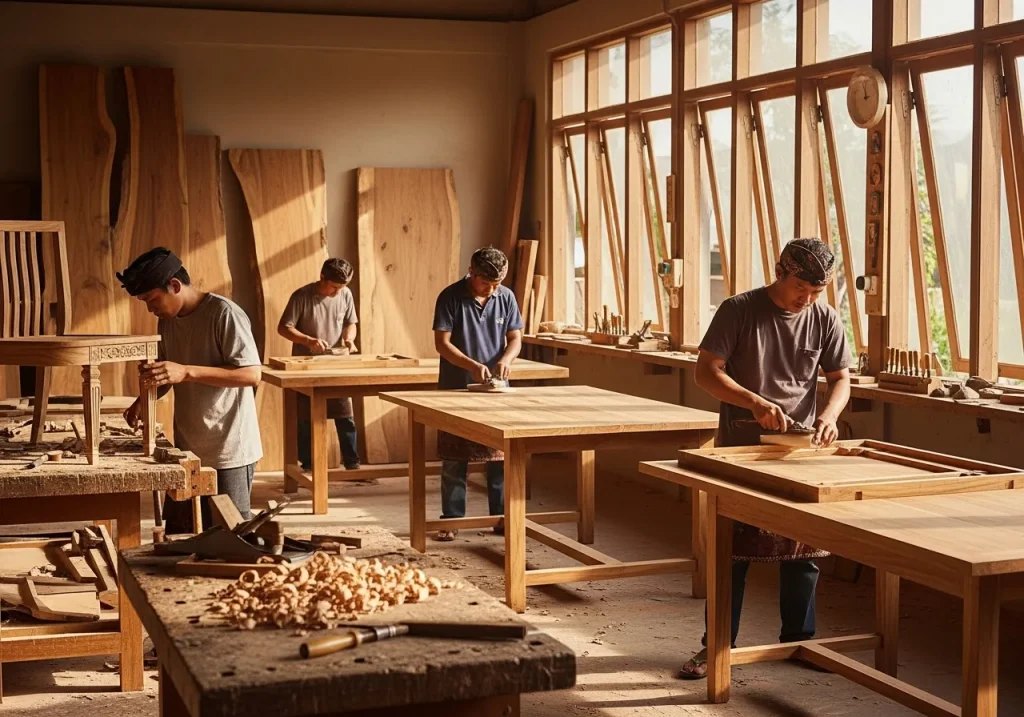
The Bali teak furniture market is experiencing steady growth, projected at mid-single-digit rates through 2027. This expansion is driven by robust tourism, numerous hospitality projects, and increasing global demand for durable outdoor furniture. Bali operates as a significant craft and export hub within Indonesia’s broader teak and wooden furniture industry, offering a diverse range of products.
Bali, a prominent hub for teak furniture production and export, offers distinct avenues for sourcing: directly from local artisans or through established online wholesalers. This comparison focuses on the practicalities for importers, wholesalers, retailers, and interior contractors seeking to procure bali teak furniture for restaurant, hotel, or retail projects. Understanding these differences is crucial for making informed procurement decisions that align with specific business requirements regarding volume, consistency, quality control, and logistical efficiency.
Understanding the Bali Teak Furniture Market Landscape
The global teak furniture market, valued at approximately USD 3.8–8.5 billion, is projected to grow at a CAGR of 4–6% into the early 2030s. Asia-Pacific consistently leads this market in both production and consumption. Within this, Indonesia is recognised as a major global producer of teak, providing a strong supply base for furniture exports. Bali’s role as a key craft and export centre contributes significantly to Indonesia’s position in the global wooden furniture industry, which in Asia-Pacific alone reached USD 166 billion in 2025.
Prices for teak furniture in Bali generally range from approximately USD 50–150 for smaller items to USD 500–2,000+ for premium sets. These variations depend on factors such as design complexity, timber grade, and certification status. The market’s growth is sustained by increasing demand for durable, weather-resistant outdoor furniture, particularly from the hospitality sector and residential projects worldwide.
2027 Note: Market Growth and Certification
By 2027, the steady mid-single-digit growth in the Bali teak furniture market is expected to continue, with an increased emphasis on certified timber. Importers should anticipate a higher prevalence of V-Legal (SVLK) certified products as regulatory scrutiny and consumer demand for sustainable sourcing practices strengthen. This trend is particularly relevant for large-scale hospitality projects and commercial ventures requiring demonstrable ethical sourcing.
Sourcing from Local Artisans in Bali
Engaging directly with local artisans offers a unique procurement experience, often characterised by customisation and direct interaction with the craftsperson. This approach is typically suited for smaller-scale projects or bespoke designs where specific aesthetic requirements take precedence over volume.
Advantages of Local Artisans
- Customisation and Bespoke Designs: Artisans are often amenable to creating unique pieces based on specific client designs or modifications. This flexibility is valuable for projects requiring distinct aesthetic elements, such as custom-designed bali teak furniture for restaurant interiors that match specific branding.
- Direct Communication: Importers can communicate directly with the maker, potentially streamlining design adjustments and material discussions. This direct line can be beneficial for understanding the crafting process and timber selection.
- Supporting Local Economy: For some buyers, the direct support of local craftsmanship and community development is a significant factor.
- Potential for Unique Finds: Artisans may produce distinctive, one-off pieces that are not available through larger wholesale channels, offering exclusivity.
Disadvantages of Local Artisans
- Limited Production Capacity: Artisans typically operate on a smaller scale, making it challenging to fulfil large wholesale orders within commercial timelines. This can result in extended lead times for significant quantities.
- Inconsistent Quality and Standardisation: While quality can be high for individual pieces, maintaining consistent standards across a large batch can be difficult. Variations in finish, dimensions, and timber grade are more probable.
- Lack of Formal Documentation and Certification: Many artisans may not provide official invoices, export documentation, or timber certifications (e.g., V-Legal/SVLK), which are essential for commercial importing and customs clearance.
- Logistical Complexity: Buyers are often responsible for arranging their own shipping, freight forwarding, and customs clearance, adding significant logistical burdens and costs.
- Payment and Contractual Risks: Formal contracts and secure payment methods may be less common, increasing financial risks for large transactions.
- Scalability Issues: Scaling up orders for multiple retail locations or large hospitality projects is often impractical due to capacity constraints.
Sourcing from Online Wholesalers in Bali
Online wholesalers, such as Teak Furniture Bali, specialise in large-volume, business-to-business transactions. They offer structured processes, quality control, and logistical support designed for international trade.
Advantages of Online Wholesalers
- High Production Capacity: Wholesalers have established workshops and supply chains capable of fulfilling large orders consistently, suitable for major retail chains, hotels, and restaurant groups.
- Standardised Quality Control: Reputable wholesalers implement stringent quality control measures to ensure uniformity in materials, construction, and finish across all products. This is critical for maintaining brand consistency.
- Formal Documentation and Certification: Wholesalers provide all necessary export documentation, commercial invoices, and timber certifications (e.g., V-Legal/SVLK), ensuring legal compliance for international shipping and customs.
- Streamlined Logistics and Shipping: They offer comprehensive logistics support, including packaging, freight forwarding, and customs assistance, simplifying the import process for buyers.
- Secure Payment and Contractual Agreements: Formal contracts and secure payment terms protect both parties, reducing financial and operational risks.
- Scalability and Reliability: Wholesalers can reliably scale production to meet growing demand and provide consistent supply for ongoing projects.
- Product Range and Design Library: They typically offer an extensive catalogue of designs, including popular styles for bali teak furniture for restaurant and hospitality, alongside options for customisation based on minimum order quantities.
Disadvantages of Online Wholesalers
- Higher Minimum Order Quantities (MOQs): Wholesalers often have MOQs, which may not be suitable for very small or one-off purchases.
- Less Flexibility for Micro-Customisation: While custom designs are possible, they usually require larger order volumes than with individual artisans. Small, intricate changes to existing designs might be less feasible without significant MOQs.
- Less Direct Artisan Interaction: Buyers interact with sales and production teams rather than the individual craftsperson, which can reduce the direct connection to the making process.
Comparative Summary: Artisans vs. Wholesalers
The table below summarises key differences relevant to commercial buyers:
| Feature | Local Artisans | Online Wholesalers (e.g., Teak Furniture Bali) |
|---|---|---|
| Production Capacity | Limited, small batches | High, large-scale orders |
| Quality Consistency | Variable, less standardised | High, standardised through QC protocols |
| Documentation & Certification | Often informal or absent | Formal, includes V-Legal/SVLK |
| Logistics & Shipping | Buyer’s responsibility, complex | Managed, streamlined, comprehensive support |
| Customisation | High flexibility for small quantities | Available for MOQs, structured process |
| Payment & Contracts | Less formal, higher risk | Secure, formal agreements |
| Pricing (per unit) | Potentially higher for small orders; varies | Competitive for wholesale volumes; transparent |
| Lead Times | Longer for large orders, less predictable | Predictable, managed for volume |
| Suitability For | Unique, small-batch, bespoke items | Volume orders, commercial projects, consistent supply |
Choosing the Right Sourcing Partner
For importers, wholesalers, retailers, and interior contractors focused on commercial-scale projects, consistency, reliability, and compliance are paramount. While local artisans provide opportunities for unique, bespoke pieces, their limitations in production capacity, standardisation, and logistical support often make them unsuitable for large wholesale requirements.
Online wholesalers, conversely, are structured to meet the demands of international B2B trade. They offer the necessary infrastructure for volume production, rigorous quality control, essential legal documentation, and integrated logistics, ensuring a smoother and more reliable supply chain. This approach minimises risk and maximises efficiency for businesses requiring substantial quantities of bali teak furniture for restaurant, hotel, or retail applications.
For consistent quality, dependable supply, and comprehensive export support, partnering with an established online wholesaler in Bali is the more pragmatic choice for trade buyers. Request a wholesale quote on WhatsApp to discuss your specific requirements: request a wholesale quote on WhatsApp.