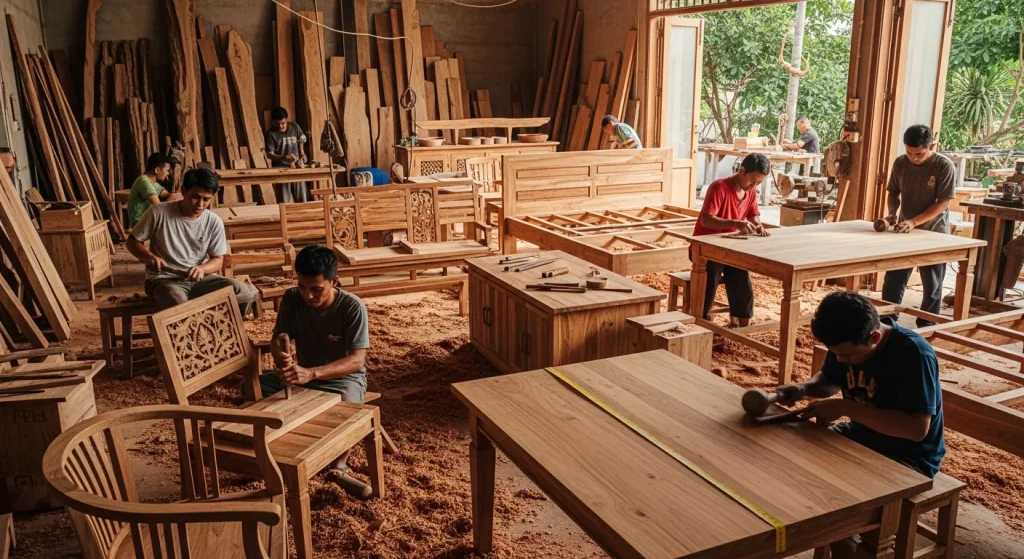
The global market for teak furniture is valued between USD 3.8 billion and USD 8.5 billion, depending on definition and year, with a projected compound annual growth rate (CAGR) of 4–6% through the early 2030s. Asia-Pacific leads both production and consumption, with Indonesia being a major global teak producer. Bali, as a significant craft and export hub, contributes to this growing market.
Buyer Alert: Why “Dry” Teak in Bali Often Splits and How to Verify Kiln-Drying First
For importers, wholesalers, retailers, and interior contractors sourcing handcrafted teak furniture made in Bali, understanding wood moisture content is critical. The term “dry” in casual conversation often refers to air-dried timber, which is insufficient for preventing splitting and warping in finished furniture, especially when exported to different climates. This article details the necessity of proper kiln-drying and how to verify it to safeguard your investment.
Understanding Moisture Content and Teak Stability
Teak (Tectona grandis) is renowned for its durability, natural oils, and resistance to pests and decay. However, even premium teak is susceptible to dimensional instability if its moisture content (MC) is not appropriately controlled. Wood naturally expands and contracts with changes in humidity. When furniture moves from a high-humidity environment, such as Bali, to a lower-humidity destination, the wood will lose moisture and shrink. If the MC is too high initially, this shrinkage can cause significant problems.
The Problem with Air-Dried Teak in Export
Many smaller workshops in Bali rely on air-drying, where timber is stacked and allowed to dry naturally over weeks or months. While air-drying can reduce MC, it typically only brings the wood down to 12-18% MC, depending on local atmospheric conditions. For furniture destined for export, particularly to temperate or arid climates, this MC is far too high. Residential and commercial indoor environments in Europe, North America, or even parts of Australia often maintain relative humidity levels that correspond to an equilibrium MC of 6-10% for wood.
When air-dried teak furniture with, for example, 15% MC arrives in a climate where the equilibrium MC is 8%, the wood will continue to dry out. This rapid and uneven moisture loss causes internal stresses, leading to:
- Splitting and Cracking: Often seen along grain lines or at joints.
- Warping and Cupping: Flat surfaces can become distorted.
- Joint Failure: Mortise-and-tenon or dowel joints can loosen as components shrink.
- Finish Damage: Finishes can crack or peel as the wood beneath moves.
The Essential Role of Kiln-Drying
Kiln-drying is a controlled process that uses heated chambers to reduce the wood’s moisture content to a specific, uniform level. For handcrafted teak furniture made in Bali, a target MC of 8-10% is generally considered suitable for most international markets. This process offers several advantages:
- Precise Moisture Control: Kilns can reduce MC to levels unattainable by air-drying, ensuring stability.
- Uniform Drying: Modern kilns dry wood more evenly throughout the thickness of the timber.
- Stress Relief: The drying schedule in a kiln can include conditioning phases that relieve internal stresses in the wood, reducing the likelihood of warping.
- Pest Eradication: The heat during kiln-drying kills insects, larvae, and fungi, preventing infestations.
2027 Note: As global demand for durable outdoor furniture and hospitality projects continues to drive the teak market, ensuring properly kiln-dried material will become an even more critical differentiator for suppliers in 2027. Importers should expect clear documentation regarding drying processes as standard practice.
Verifying Kiln-Drying: What to Ask and Inspect
When sourcing handcrafted teak furniture from Bali, it is imperative to verify that the timber has been properly kiln-dried. Simply taking a supplier’s word that the wood is “dry” is insufficient. Here are concrete steps and questions to pose:
1. Request Kiln Specifications and Schedules
Ask your supplier for details about their kiln-drying facilities or those of their timber supplier. A professional operation should be able to provide:
- Kiln Type and Capacity: Information about the kilns used.
- Drying Schedules: Documentation outlining the temperature, humidity, and duration for drying specific timber thicknesses.
- Target Moisture Content: Confirmation of the final MC percentage achieved.
2. On-Site Inspection and Moisture Meter Readings
If possible, conduct an on-site inspection or arrange for an independent third-party inspection. Use a reliable, calibrated pin-type moisture meter. Take multiple readings from different parts of various timber pieces and finished furniture items. Readings should consistently be within the 8-10% range. Be wary if readings are significantly higher.
3. Supplier Transparency and Communication
A reputable supplier of handcrafted teak furniture made in Bali will be transparent about their drying processes and quality control. They should readily answer questions and provide evidence of their practices. Hesitation or vague answers should be a red flag.
4. Consider Certifications (SVLK, FSC)
While not directly related to kiln-drying, certifications like the Indonesian Timber Legality Verification System (SVLK) or Forest Stewardship Council (FSC) indicate a more structured and professional supply chain. Suppliers adhering to such standards are generally more likely to have robust quality control processes, including proper timber preparation.
The Cost of Quality vs. The Risk of Failure
Kiln-drying adds to the production cost of teak furniture. However, this is a necessary investment that prevents costly issues down the line. The global teak furniture market, valued at USD 3.8–8.5 billion, consistently sees Asia-Pacific as the leading region for production. Indonesia is a major producer of teak, making Bali a significant hub for this industry. Prices for handcrafted teak furniture made in Bali can range from approximately USD 50–150 for small items to USD 500–2,000+ for premium sets, depending on design and certification. The additional cost for properly dried timber is a small percentage of these figures but offers immense protection against product failure and customer dissatisfaction.
The table below outlines the typical moisture content ranges and their implications:
| Drying Method | Typical Moisture Content (MC) | Suitability for Export Furniture | Risk of Splitting/Warping |
|---|---|---|---|
| Green (Freshly Cut) | 30% – 100%+ | Unsuitable | Very High |
| Air-Dried | 12% – 18% | Generally Unsuitable | High (in dry climates) |
| Kiln-Dried | 8% – 10% | Suitable | Low |
Conclusion
For importers, wholesalers, and trade buyers, ensuring that your handcrafted teak furniture made in Bali is produced from properly kiln-dried timber is a non-negotiable quality control measure. The market for teak furniture continues to grow at mid-single-digit rates through 2027, driven by strong demand for durable outdoor and indoor pieces. Protecting your reputation and investment means partnering with suppliers who adhere to strict timber preparation standards. Always verify kiln-drying to prevent costly product failures and maintain client satisfaction.
To discuss your wholesale requirements for handcrafted teak furniture and our quality assurance processes, request a wholesale quote on WhatsApp.